
Common Loons Immigration

Blog

Your blog category

Canada Visitor Visa Fees 2025

Canada Visitor Visa Fees 2025: Complete Guide to Application, Biometrics, Family Packages & Hidden Costs

A trip to Canada, known for its breathtaking landscapes and vibrant cities, starts long before you board the flight—it begins with the visa application. For Indian travelers, navigating the fee structure for a Canada Visitor Visa (also called a Temporary Resident Visa or TRV) can feel complex. Costs include the official Canada visitor visa application fee, mandatory biometrics, and additional VFS Global Canada visa charges for passport handling and services. This guide provides a complete breakdown of Canada visitor visa fees in 2025, helping you budget accurately and avoid hidden expenses. Why Understanding Canada Visitor Visa Fees Matters Knowing the upfront visa costs is essential for effective travel planning. The official charges are set by Immigration, Refugees and Citizenship Canada (IRCC) in Canadian Dollars (CAD) and converted to Indian Rupees (INR) based on current exchange rates. Since exchange rates fluctuate, the INR values in this guide are approximate. This article covers: The government application fee The Canada visa biometric fee Family packages and exemptions The often-overlooked hidden charges in Canada visitor visa processing Real examples of total costs from India Canada Visitor Visa Fees (Government Charges) These are the mandatory fees paid to IRCC. All fees are non-refundable, even if your visa is refused. Fee Type Cost in CAD Approx. Cost in INR Notes Single/Multiple Entry Visa CAD 100 per person ₹6,000 Standard Canada tourist visa fees. Family Package Fee (5+ Applicants) CAD 500 flat ₹30,000 Maximum cap for families applying together. Extension of Stay (Visitor Record) CAD 100 ₹6,000 Canada visitor visa extension fee while in Canada. Restoration of Status CAD 200 ₹12,000 If your visa has expired and needs restoration. 👉 Tip: If you’re applying as a family, the Canada family visitor visa fees cap (CAD 500) is much cheaper than applying individually. Biometric Fees (Mandatory for Most Applicants) Most Indian applicants must submit fingerprints and a photo. This cost is in addition to the application fee. Biometric Fee Type Cost in CAD Approx. INR Notes Per Person CAD 85 ₹5,100 Standard biometric fee. Family (2+ applicants) CAD 170 ₹10,200 Maximum fee per family. Group of Performing Artists (3+) CAD 255 ₹15,300 For groups traveling together. Exemptions Not everyone has to pay the full set of charges. Some categories of travelers are partially or fully exempt from Canada visa biometric fee or other charges. Knowing these exemptions can help you calculate your Canada visitor visa cost from India more accurately: Biometric Exemptions Children under 14 years of age do not need to provide biometrics. Applicants over 79 years of age are also exempt. If you have already submitted biometrics within the last 10 years for any Canadian visa category, you may not need to provide them again. The IRCC system will automatically verify your records. Visa Fee Exemptions Generally, the Canada visitor visa application fee of CAD 100 applies to all applicants. However, there may be exemptions in rare humanitarian cases or for certain diplomatic or official visa applicants. Passport Transmission Fee Exceptions If you submit your application online and are exempt from biometrics, you will still need to pay VFS Global’s passport submission fee—but in-person collection can help you avoid courier costs. Special Groups Groups of three or more performing artists applying together for temporary work or visitor visas pay a capped biometric fee of CAD 255, regardless of group size. This can be cheaper than paying individually. ⚠️ Even if a child is exempt from biometrics, parents must still pay VFS Global package transmission fees when submitting passports. Additional Costs Many Forget About The official IRCC fees are just the start. Several hidden charges in Canada visitor visa processing can add up: Cost Category Estimated in INR Notes VFS Global Service Fees ₹500 – ₹1,500 Includes package transmission, assisted form-filling. Passport Courier Return ₹500 – ₹1,500 For safe delivery of stamped passport. Currency Conversion + GST 3% – 5% Charged by banks for international payments. SMS Tracking Updates ₹300 – ₹500 Optional service from VFS Global. Resubmission/Correction Varies Charged if documents need correction. 👉 When calculating your Canada visitor visa cost from India, always factor in these local service charges. Visitor Visa Processing Time & Fees by Category Processing time varies by case and is updated regularly on the IRCC site. Category Average Processing Time Notes Standard Processing 30 – 120+ days ~47 days average from India. Priority/Urgent Not available Only in medical/humanitarian emergencies. Checking the latest Canada visitor visa processing time fees is crucial, as delays may affect your travel plans. Sample Cost Calculation (From India, 2025) Here’s how the combined Canada visitor visa application fee and biometrics add up: Applicant Type Visa Fee (CAD) Biometric Fee (CAD) Subtotal (CAD) Approx. INR Solo Traveler 100 85 185 ₹11,100 Couple 200 170 (family cap) 370 ₹22,200 Family of 4 (2 adults + 2 kids under 14) 500 (family cap) 170 (parents only) 670 ₹40,200 Family of 5 (all over 14) 500 (family cap) 170 (family cap) 670 ₹40,200 👉 Add VFS service charges (₹1,000 – ₹3,000) on top of these totals. Tips to Save Money on Your Canada Visitor Visa Applying for a Canadian visa doesn’t have to burn a hole in your pocket. While the Canada visitor visa application fee and biometric costs are fixed by IRCC, there are smart ways to reduce additional expenses and avoid paying unnecessary charges: Apply as a Family If you’re traveling as a family, don’t submit individual applications separately. The Canada family visitor visa fees cap at CAD 500, which can save you thousands of rupees compared to paying CAD 100 per person. Similarly, biometric fees are capped at CAD 170 for a family, even if you’re five or more members. Apply Online Instead of Paper Paper applications at VFS Global usually mean additional service charges for document handling, scanning, and submission. Submitting online reduces those extra VFS Global Canada visa charges, as you only need to pay for mandatory services like passport transmission. Submit Correct Documents the First Time Incomplete or incorrect paperwork can lead to rejection,
Canada Visitor Visa Fees 2025: Complete Guide to Application, Biometrics, Family Packages & Hidden Costs Read More »

list of 7 Reasons Sponsorship Application Denied

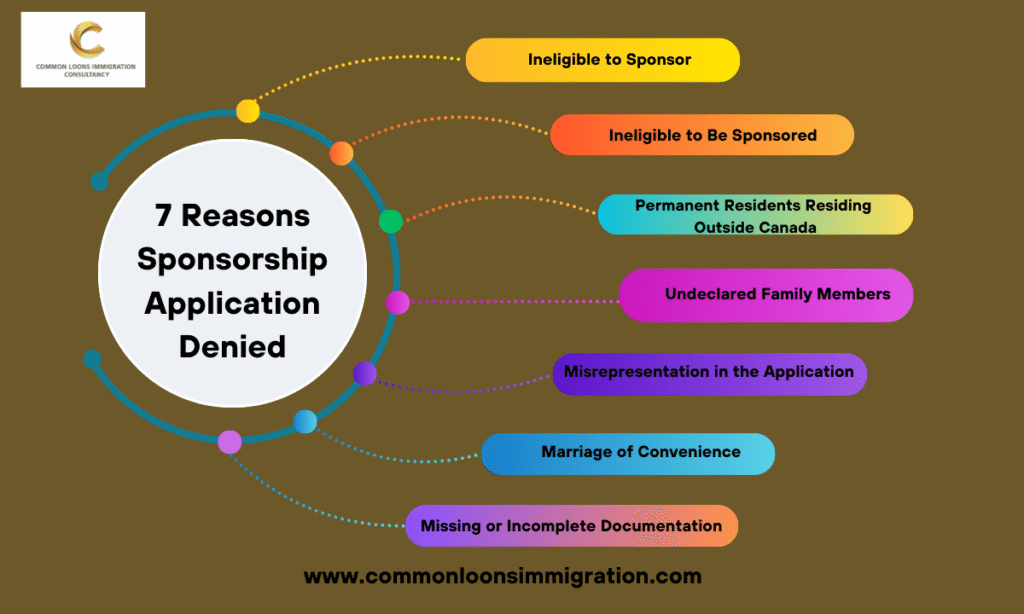
7 Common Reasons Your Spousal Sponsorship Application Could Be Denied in Canada (And How to Avoid Refusal)

Family reunification is at the heart of Canadian immigration policy, but navigating the spousal sponsorship process can be overwhelming. Each year, thousands of families face refusal due to technical errors, eligibility gaps, or misrepresentation. Understanding the most common reasons for refusal is the first step to avoiding costly mistakes and increasing your chances of success. At Common Loons Immigration, we have helped countless families reunite through careful guidance on sponsorship applications. This article breaks down the top reasons for spousal sponsorship refusals in Canada, explains the refusal context in 2025, and outlines steps to take if your application is refused—including appeals and reapplications. 1. Ineligible to Sponsor Being a Canadian citizen or permanent resident alone does not guarantee sponsorship eligibility. To meet the requirements of sponsorship in Canada, you must: Be at least 18 years old. Live in Canada or, if a citizen living abroad, show clear intent to return once your spouse becomes a permanent resident. Not be on social assistance (except for disability). Have no history of defaulting on family support payments, immigration bonds, or loans. Not have a serious criminal record. Important: Permanent residents must reside physically in Canada to sponsor. While there is no minimum income requirement for sponsoring a spouse or dependent child, providing financial documents like tax returns or pay stubs strengthens your case. 2. Ineligible to Be Sponsored Your spouse or partner must also meet IRCC’s eligibility criteria for Canada immigration family sponsorship: Must be legally married, in a common-law relationship (at least one year), or recognized conjugal partners. Engagements or fiancés alone do not qualify. Applicants with a criminal record or security risk are inadmissible. Serious medical conditions deemed inadmissible can also cause refusal. 3. Permanent Residents Residing Outside Canada Canadian citizens can sponsor from abroad if they demonstrate intent to return. Permanent residents, however, cannot sponsor while living outside Canada. If they attempt to do so, the application will be refused. 4. Undeclared Family Members All family members must be declared—even if you don’t intend to sponsor them. Failure to do so can: Lead to immediate refusal. Jeopardize your own permanent resident status. Make undeclared relatives permanently ineligible for sponsorship. This is one of the most unforgiving rules in Canadian immigration law. 5. Misrepresentation in the Application Misrepresentation—whether accidental or deliberate—is a major reason for refusal. Examples include: Incomplete or inconsistent information. Providing false relationship evidence. Submitting outdated forms. Consequences: Immediate refusal and a five-year ban on applying for permanent residence. To avoid this, double-check all documents, use certified translations when needed, and consider working with an immigration lawyer for sponsorship to ensure accuracy. 6. Marriage of Convenience (Fraudulent Marriage) IRCC scrutinizes applications to prevent fraudulent marriages. Officers assess factors like: Very short courtships. Large cultural, language, or age differences without explanation. Inconsistent answers during interviews. Lack of shared financial or residential ties. How to prove your marriage is genuine: Provide joint financial records (bank accounts, bills, leases). Submit photographs showing the progression of your relationship. Include communication records (calls, texts, emails). Collect affidavits from family and friends. This reason is highly subjective, so strong documentation is critical. 7. Missing or Incomplete Documentation Even minor mistakes can trigger refusal. Common missing items include: Marriage certificate or proof of common-law status. Police clearance certificates. Medical exam results. Signatures on application forms. Always use the latest IRCC forms and confirm all required documents are included before submission. Additional Key Considerations Incomplete or Outdated Forms Applications using outdated IRCC forms or missing signatures are automatically refused. Always download the latest package directly from IRCC. Financial Stability While no set income threshold applies to spousal sponsorship, proof of stable finances reassures officers that you can meet your spouse’s needs without relying on social assistance. Medical & Criminal Admissibility Your spouse must pass a medical exam and provide police certificates from every country they lived in for 6+ months since age 18. Serious issues can result in inadmissibility. Inland vs. Overseas Sponsorship Inland: For spouses already in Canada. They may be eligible for an open work permit. If refused, they risk losing temporary status. Overseas: Processed abroad. Refusals can usually be appealed at the Immigration Appeal Division (IAD). Processing Times (2025) Average processing time is around 12 months, but complete, well-prepared applications move faster. Updated Refusal Rates in 2025 Roughly 15–20% of spousal sponsorship applications are refused. Many refusals result from avoidable mistakes like incomplete forms, undeclared relatives, or weak proof of relationship. What Happens If Your Spousal Sponsorship Is Rejected? Reapply: Fix issues and submit a stronger application. Appeal: File an appeal with the Immigration Appeal Division (IAD) within 30 days (for overseas applications). Judicial Review: Some inland refusals can be challenged in Federal Court. Legal Support: An immigration lawyer can identify mistakes, gather stronger evidence, and represent you in appeals. Applicant Checklist to Avoid Refusal  Confirm sponsor eligibility. Confirm spouse’s admissibility. Use current IRCC forms and complete all sections. Provide consistent and honest information. Declare all family members. Include police and medical documents. Submit strong relationship proof. Consider hiring an immigration lawyer for sponsorship support. How an Immigration Lawyer Can Help At Common Loons Immigration, we: Assess eligibility before submission. Identify weaknesses in your application. Compile strong evidence of a genuine relationship. Represent clients in appeals and judicial reviews. Minimize errors that lead to refusals or delays. Working with a trusted immigration lawyer is often the difference between a fast approval and a stressful refusal. FAQs on Spousal Sponsorship Refusal Q: What are the most common reasons for spousal sponsorship refusal in Canada? A: Ineligibility to sponsor, ineligible spouse, misrepresentation, missing documents, undeclared family members, living outside Canada as a PR, and suspected marriage of convenience. Q: Can permanent residents sponsor from outside Canada? A: No. Only Canadian citizens can sponsor from abroad, provided they show intent to return. Q: How long does spousal sponsorship take in 2025? A: Average processing time is around 12 months, but varies by case. Q: What should I do if my spousal sponsorship is refused? A: Review

7 Common Reasons Your Spousal Sponsorship Application Could Be Denied in Canada (And How to Avoid Refusal) Read More »